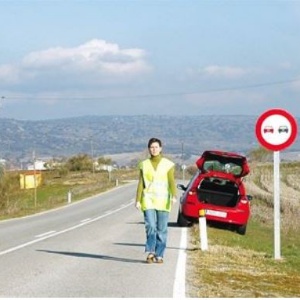
Must a vehicle which has broken down and stopped on the shoulder be marked?
View explanation
A broken-down vehicle stopped on the hard shoulder still needs to be clearly signalled, because it can remain a traffic hazard (drivers may drift onto the shoulder, the vehicle may protrude, and the scene can trigger sudden manoeuvres).
The DGT’s recommended procedure is to activate the hazard warning lights and use the V16 emergency beacon.
- Rule change (01/01/2026): from 1 January 2026, the connected V16 is mandatory and becomes the only legal pre-warning device in Spain; warning triangles stop being the mandatory/legal device.
- Best practice: place the V16 on the highest point (typically the roof) so it’s visible from far away without walking on the carriageway.
Another official driving test related
Are motorways and dual carriageways considered safer than conventional roads?
Where should you go to turn to the left on this two-way, three-lane road?
On a three-lane motorway, the right-hand lane is free. On which lane must you travel?
On interurban roads with three or more lanes for the same direction of traffic, can a set of vehicles over 7 meters long use the lane next to the right lane?
Do you want to take the official DGT tests?
Start the exam