Getting a Driver's License in Spain in English
Content index
- Can you get a Spanish driving licence in English?
- Who can apply for a Spanish driving licence?
- What is normal residence?
- Can foreign students apply?
- Do you need a new Spanish licence if you already have a foreign one?
- What if you have a non-EU driving licence?
- What can you drive with a category B licence?
- What is the minimum age for category B?
- Can every driving licence test be taken in English?
- How do you request the theory test in English?
- Is the practical examination conducted in English?
- Do you have to attend a driving school?
- How to choose a driving school for English-speaking students
- Is there a minimum number of practical lessons?
- Step 1: obtain the psychophysical fitness report
- Can the medical examination be completed in English?
- Step 2: prepare the application documents
- Do you need two passport photographs?
- Step 3: pay the DGT examination fee
- How many examination attempts are included?
- Step 4: submit the examination application
- Step 5: study the Spanish traffic rules in English
- Spanish traffic terminology in English
- Study the updated Spanish traffic signs
- How is the category B theory test structured?
- How should you prepare for the English test?
- Common translation problems in theory questions
- Can you request audio or accessibility support?
- Step 6: check the theory-test result
- How long is the passed theory test valid?
- Step 7: complete practical training
- Step 8: take the practical test
- What happens if you do not understand an instruction?
- What happens after passing?
- Can you drive immediately after seeing the result?
- Can the provisional licence be used outside Spain?
- How long is the Spanish category B licence valid?
- Common mistakes made by English-speaking applicants
- Frequently asked questions
- Can foreigners obtain a Spanish driving licence?
- Can I take the category B theory test in English?
- Will the practical examiner speak English?
- Can I use an interpreter in the practical test?
- Is the motorcycle theory test available in English?
- Do I have to attend a driving school?
- Is there a compulsory minimum number of practical lessons?
- How many questions are in the category B theory test?
- How many examination attempts are included in the fee?
- How long is the passed theory test valid?
- How long is the medical report valid?
- Can I drive immediately after passing the practical test?
- How long is the provisional licence valid?
- When will the definitive licence arrive?
- What if I already have a foreign licence?
- Conclusion
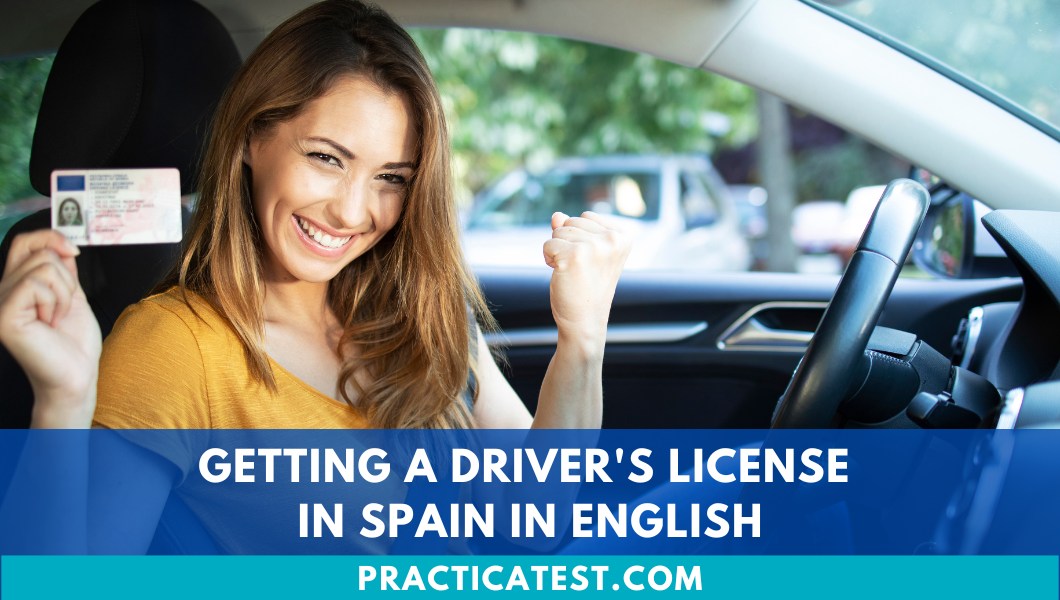
If you live in Spain and need to obtain a category B driving licence, you can generally request the common theory test in English.
This allows foreign applicants to study Spanish traffic rules and answer the official multiple-choice questions without taking the theory examination in Spanish.
However, requesting the English theory test does not mean that every part of the driving licence process will automatically be provided in English. The administrative procedure, medical examination, practical lessons and examiner’s instructions may still require communication in Spanish.
This guide explains who can obtain a Spanish licence, how to request the theory test in English, which documents are needed and what happens after passing the practical test.
Can you get a Spanish driving licence in English?
You can generally request the common category B theory test in English when submitting your examination application.
The category B licence allows you to drive ordinary cars and other vehicles within the limits established by Spanish law.
The process still requires you to:
- Meet the residence requirements.
- Meet the minimum age.
- Pass a psychophysical fitness examination.
- Submit the official application.
- Pay the corresponding DGT fee.
- Pass the theory test.
- Pass the practical driving examination.
Who can apply for a Spanish driving licence?
Nationality does not prevent a person from obtaining a Spanish driving licence.
An applicant must generally:
- Have normal or legally recognised residence in Spain.
- Meet the minimum age for the requested category.
- Have the required psychophysical abilities.
- Not be deprived by a court of the right to drive.
- Not be subject to an administrative suspension or intervention.
- Not hold another equivalent EU or EEA driving licence.
- Pass the required theory and practical tests.
A medical condition or disability does not automatically prevent a person from obtaining a licence. Depending on the assessment, the licence may include adaptations, restrictions or a shorter validity period.
What is normal residence?
Normal residence is generally the place where a person habitually lives for at least 185 days during each calendar year because of personal or professional ties.
Foreign applicants may need to prove their identity and residence using documents such as:
- A foreigner identity card.
- An EU citizen registration certificate.
- A valid residence authorisation.
- A passport together with the corresponding residence document.
- Other documentation requested by the Traffic Office.
Municipal registration may help prove an address, but it does not necessarily establish every legal-residence requirement by itself.
Can foreign students apply?
A foreign student may be able to obtain a Spanish licence when the applicable conditions are met.
A non-EU foreign student must normally prove that they have been studying in Spain continuously for at least six months and must also meet the minimum-age, medical and examination requirements.
This rule does not mean that every foreign resident must wait six months before beginning the process.
Do you need a new Spanish licence if you already have a foreign one?
Not necessarily. Before applying for a new licence, check whether your existing permit is valid or exchangeable in Spain.
You may not need to take new tests if:
- You have a valid licence issued by an EU or EEA country.
- Your licence was issued by a country with an exchange agreement with Spain.
- The licence and its categories meet the conditions of the agreement.
- You obtained it before becoming legally resident in Spain when this is required.
A valid EU or EEA licence is normally recognised in Spain while it remains in force. Its exchange is generally voluntary.
Our guide to EU and EEA driving licences in Spain explains when exchange or renewal may become necessary.
What if you have a non-EU driving licence?
An eligible non-EU licence may generally be used for a maximum of six months after the holder acquires normal residence in Spain.
After that period:
- The licence must be exchanged when an agreement permits it; or
- The holder must obtain a new Spanish licence when no exchange is possible.
Submitting an exchange application does not automatically extend the right to drive.
You can compare the available procedures in our guide to Spanish driving licences for foreign residents.
What can you drive with a category B licence?
The category B licence principally authorises you to drive motor vehicles with:
- A maximum authorised mass not exceeding 3,500 kilograms.
- No more than eight passenger seats in addition to the driver’s seat.
- A trailer with a maximum authorised mass not exceeding 750 kilograms.
- Certain heavier trailer combinations when the applicable mass limits are respected.
It also authorises certain three-wheeled, four-wheeled and other vehicles under the conditions established by Spanish law.
The licence does not automatically authorise every:
- Motorcycle.
- Heavy trailer combination.
- Lorry.
- Bus.
- Professional transport activity.
The main conditions are explained in the section on administrative requirements for driving a motor vehicle.
What is the minimum age for category B?
The ordinary minimum age for obtaining the category B licence is 18 years.
You may take the first theory-test attempt during the three months before reaching the minimum age. However, you cannot obtain or use the ordinary licence independently before meeting the legal age requirement.
Can every driving licence test be taken in English?
No. The English option should not be assumed for every licence category or examination.
The common category B theory test can generally be requested in English, but availability may be different for:
- Motorcycle-specific theory tests.
- Lorry and bus examinations.
- Trailer tests.
- Professional qualifications.
- Special vehicle licences.
- Dangerous-goods authorisations.
Before submitting the application, confirm that English is available for the exact test you need.
How do you request the theory test in English?
The requested examination language must be indicated when the application is submitted.
If a driving school manages your application, tell the school clearly that you want the official category B theory test in English.
Before the application is finalised, check that:
- The correct licence category has been selected.
- English appears as the theory-test language.
- Your name and identification details are correct.
- The correct examination province is shown.
- Any authorised accessibility requirement has been recorded.
Do not wait until the examination day to request a language change. The examination centre prepares the test according to the information in the application.
Is the practical examination conducted in English?
The practical examination is not a written language test. The examiner gives directions and evaluates the candidate’s ability to drive safely.
You should not assume that an English-speaking examiner will be provided. Candidates must be prepared to understand the instructions used during the test.
Common practical instructions may concern:
- Moving off.
- Following a direction.
- Taking an exit.
- Turning at a junction.
- Changing direction.
- Parking.
- Stopping safely.
- Following signs towards a destination.
A driving school can help English-speaking students learn the basic Spanish expressions used during practical lessons and examinations.
Do you have to attend a driving school?
Theory preparation and the administrative application can be completed independently.
However, using a driving school is the usual option because it can:
- Submit the application.
- Record the requested examination language.
- Provide English study material.
- Manage examination dates.
- Provide practical lessons.
- Supply the required dual-control vehicle.
- Manage the examination file.
- Deliver the provisional licence after approval.
Preparing independently does not remove the requirement to pass the same official tests.
How to choose a driving school for English-speaking students
Before enrolling, ask the school:
- Whether the theory material is fully available in English.
- Whether explanations are provided by an English-speaking teacher.
- Whether the questions are updated for the current Spanish rules.
- Whether practical lessons can be explained in English.
- Whether instructors teach the Spanish commands used in the practical test.
- What services are included in the price.
- How examination and vehicle fees are charged.
- Whether the school manages foreign-applicant documentation.
A translated manual alone may not be enough if the translation is outdated or uses terms different from those appearing in the official test.
Is there a minimum number of practical lessons?
There is no universal statutory minimum number of category B practical lessons that every applicant must complete.
The number needed depends on:
- Previous driving experience.
- Ability to control the vehicle.
- Knowledge of Spanish traffic rules.
- Observation and anticipation.
- Understanding of the examiner’s instructions.
- The instructor’s assessment.
Experience obtained in another country can be helpful, but it can also include habits that do not match the Spanish examination criteria.
Step 1: obtain the psychophysical fitness report
Before applying for the tests, attend an authorised Driver Recognition Centre and state which licence category you want to obtain.
The examination normally checks:
- Eyesight.
- Hearing.
- Coordination.
- Reaction ability.
- General medical condition.
- Medication relevant to driving.
The centre may take the photograph needed for the procedure and transmit the medical result electronically.
The psychophysical fitness report must normally be used to submit the examination application within 90 days.
Can the medical examination be completed in English?
An authorised medical centre is not automatically required to provide an English-speaking professional.
Before attending, ask whether the centre can explain the procedure in English, especially if you need to discuss:
- A medical condition.
- Prescription medication.
- A disability.
- Visual or hearing limitations.
- Vehicle adaptations.
You must provide accurate medical information even when communication in Spanish is difficult.
Step 2: prepare the application documents
The exact documents depend on your nationality and application method, but you will generally need:
- The official application form.
- A valid identity document.
- Proof of legal or normal residence in Spain.
- Proof of student status when applying under that provision.
- The psychophysical fitness report.
- Proof of payment of the DGT fee.
- A recent photograph when required.
- The declarations contained in the official application.
You must declare that you:
- Have not been deprived by a court of the right to drive.
- Are not subject to an administrative suspension or intervention.
- Do not hold another equivalent EU or EEA licence.
- Have not had an equivalent licence restricted, suspended or cancelled in another Member State.
The Traffic Office may request additional documents when identity or residence cannot be verified electronically.
Do you need two passport photographs?
Not necessarily. The current procedure should be followed rather than relying on old lists that automatically request two photographs.
In many cases, the authorised medical centre captures or manages the image used for the application. However, a physical photograph may still be required in certain procedures.
Check the current instructions for your application method before obtaining photographs.
Step 3: pay the DGT examination fee
The DGT fee must be paid before taking the tests.
This administrative fee does not include:
- The medical examination.
- Driving-school registration.
- Theory classes.
- Practical lessons.
- The use of the driving-school vehicle.
- Additional management services.
The amount can be updated, so check the current DGT rate rather than relying on an old fixed price.
How many examination attempts are included?
The ordinary DGT examination fee gives the applicant two attempts shared between the required examinations.
For example:
- If you pass theory on the first attempt, you normally retain two practical attempts.
- If you fail theory once and pass it on the second attempt, a new fee is required before taking the practical test.
- If you fail the practical test twice, you must submit a new application and pay another fee.
The two attempts should not be confused with the two-year validity period of a test that has been passed.
Step 4: submit the examination application
If you use a driving school, the school normally submits the application on your behalf.
If you apply independently, you must provide the required documentation and request the examinations through the procedure established by the DGT.
The application must correctly identify:
- The category requested.
- The theory-test language.
- The applicant’s personal information.
- The examination province.
- Any authorised adaptation or accessibility need.
An administrative appointment is not necessarily the final examination date. The application must first be processed and the test scheduled.
Step 5: study the Spanish traffic rules in English
The English theory test examines Spanish traffic legislation. It is not based on the rules of the United Kingdom, Ireland, the United States or another English-speaking country.
You must study:
- Spanish traffic signs.
- Road markings.
- Priority rules.
- Spanish speed limits.
- Overtaking rules.
- Stopping and parking.
- Alcohol and drug restrictions.
- Safety distances.
- Motorways, dual carriageways and conventional roads.
- Vehicle lighting.
- Basic vehicle maintenance.
- Protection of vulnerable road users.
- Behaviour in accidents and emergencies.
Do not translate answers according to the rules of your home country. The correct answer is always determined by Spanish legislation and the circumstances shown in the question.
Spanish traffic terminology in English
Some concepts can cause confusion because different English translations are used by manuals, driving schools and online tests.
Examples include:
- Autovía: dual carriageway or expressway, depending on context.
- Autopista: motorway.
- Carretera convencional: conventional road.
- Arcén: hard shoulder or shoulder.
- Calzada: carriageway.
- Carril: lane.
- Cambio de rasante: brow of a hill or change of gradient.
- Ceda el paso: give way or yield.
- Masa máxima autorizada: maximum authorised mass.
Learning the Spanish term together with its English equivalent can help you during practical lessons and when reading vehicle documents.
Study the updated Spanish traffic signs
Spanish signs are based on international conventions, but their names, codes and exact application are governed by Spanish regulations.
You should know:
- Warning signs.
- Priority signs.
- Prohibition and restriction signs.
- Mandatory signs.
- Information signs.
- Road markings.
- Traffic-light signals.
- Police officer signals.
- Temporary signs.
The current signs and their meanings can be reviewed in the topic on Spanish vertical traffic signs updated for 2026.
How is the category B theory test structured?
The ordinary category B theory examination generally has:
- 30 questions.
- Three possible answers for each question.
- Only one correct answer.
- A maximum of three errors to pass.
The examination may include:
- Text questions.
- Photographs.
- Traffic diagrams.
- Road signs.
- Situations requiring risk assessment.
- Audiovisual hazard-perception content.
The DGT has maintained the general 30-question structure while introducing material intended to evaluate the candidate’s understanding of real traffic risks.
How should you prepare for the English test?
A good preparation plan should include:
- Read the complete updated theory material.
- Learn the most important Spanish terms.
- Complete topic-based tests.
- Review every incorrect answer.
- Identify whether the mistake was legal, visual or linguistic.
- Complete full mock examinations.
- Practise answering within the available time.
- Review recently updated regulations.
Memorising answers without understanding the rule is risky because the same topic can appear with different wording or a different image.
Common translation problems in theory questions
An English question may still require careful reading because words such as may, must, should and is permitted have different legal implications.
Pay particular attention to:
- Questions containing “always” or “never”.
- Negative questions.
- Differences between recommendation and obligation.
- Maximum and minimum speeds.
- Vehicle classifications.
- Maximum authorised mass.
- Exceptions to general rules.
- Whether the road is urban or interurban.
The image and wording together normally provide the information needed to identify the type of vehicle, road or situation.
Can you request audio or accessibility support?
The DGT provides accessibility measures for candidates with specific learning difficulties or disabilities.
Depending on the circumstances, available measures may include:
- Questions adapted to plain language.
- Audio support for computer-based theory questions.
- Procedures for candidates with reduced mobility.
- Adapted vehicles.
- Other authorised examination adjustments.
These measures are not granted merely because Spanish is not the candidate’s first language. A request should be supported by the documentation required for the particular accommodation.
Step 6: check the theory-test result
The publication time depends on how the test was completed.
Results are normally available:
- From the afternoon of the same day for computer-based theory tests.
- From the following day for paper-based tests.
The result shows whether the candidate is:
- Apto: passed.
- No apto: failed.
Passing the theory test does not authorise you to drive independently.
How long is the passed theory test valid?
A passed test remains valid for two years.
You must complete the remaining examinations and obtain the licence within that period. Otherwise, you may have to repeat the expired tests.
If you move to another province or change driving schools, the passed test can remain valid, but an examination-file transfer may be required.
Step 7: complete practical training
Practical lessons should prepare you for Spanish roads and examination criteria.
Training should include:
- Vehicle safety checks.
- Correct seating and mirror adjustment.
- Moving off safely.
- Use of gears and controls.
- Observation and blind spots.
- Junctions and roundabouts.
- Lane changes.
- Pedestrian and cyclist safety.
- Urban and interurban roads.
- Motorways and dual carriageways.
- Parking and reversing.
- Independent driving.
- Understanding the examiner’s instructions.
Foreign applicants should pay particular attention to differences between Spanish rules and the driving practices of their home country.
Step 8: take the practical test
During the road examination, the examiner assesses whether you can drive safely and independently.
The examiner may evaluate:
- Preliminary checks.
- Observation before moving.
- Vehicle control.
- Position on the road.
- Speed selection.
- Safety distances.
- Priority decisions.
- Compliance with signs and markings.
- Interaction with vulnerable users.
- Parking and other manoeuvres.
- Anticipation of hazards.
- Safe and efficient driving.
The test can include a period of independent driving during which you follow signs or directions towards a destination.
What happens if you do not understand an instruction?
Do not guess dangerously or make a sudden manoeuvre.
If you do not understand an instruction:
- Remain calm.
- Continue driving safely.
- Ask for the instruction to be repeated when possible.
- Do not brake or change direction abruptly.
- Follow the road unless a clear safe instruction is understood.
Missing a turn is generally safer than performing a dangerous last-second manoeuvre.
What happens after passing?
After passing the final required test, the DGT begins issuing your licence.
You will normally receive a provisional authorisation that:
- Is valid for three months.
- Allows you to drive within Spain.
- Must be accompanied by valid identification.
- Cannot automatically be used abroad.
The definitive licence normally arrives at your registered address approximately one and a half months later, although delivery times may vary.
Can you drive immediately after seeing the result?
A passing result does not by itself replace the official provisional licence.
Before driving independently, make sure:
- The provisional authorisation has been issued.
- It remains valid.
- You carry valid identification.
- The vehicle is insured and authorised to circulate.
Can the provisional licence be used outside Spain?
No. The provisional Spanish licence is intended for driving within Spain while the definitive card is being produced.
You should wait for the definitive licence before driving in another country.
How long is the Spanish category B licence valid?
The ordinary category B licence is generally valid for:
- Ten years until the holder reaches the age of 65.
- Five years from the age of 65.
The validity period may be reduced when the holder has a medical condition requiring more frequent review.
Common mistakes made by English-speaking applicants
- Assuming that the entire process will be conducted in English.
- Failing to select English on the application.
- Using theory material based on another country’s rules.
- Studying with outdated translations.
- Confusing English traffic terms with Spanish vehicle classifications.
- Waiting until the examination day to request a language change.
- Assuming that every licence category is available in English.
- Ignoring the Spanish instructions used during the practical test.
- Confusing the two examination attempts with the two-year validity period.
- Driving before receiving the provisional licence.
- Trying to use the provisional licence outside Spain.
Frequently asked questions
Can foreigners obtain a Spanish driving licence?
Yes. Foreign applicants can obtain a Spanish licence when they meet the residence, age, medical and examination requirements.
Can I take the category B theory test in English?
Yes. The common category B theory test can generally be requested in English when submitting the application.
Will the practical examiner speak English?
This is not guaranteed. You should prepare to understand the basic Spanish instructions used during the practical examination.
Can I use an interpreter in the practical test?
Do not assume that an interpreter will be permitted in the vehicle. Any communication or accessibility requirement must be discussed before the test date.
Is the motorcycle theory test available in English?
Language availability can differ according to the test. Confirm the option for the exact motorcycle category before applying.
Do I have to attend a driving school?
You may prepare the theory test and submit the application independently, but most candidates use a driving school for practical training and examination management.
Is there a compulsory minimum number of practical lessons?
There is no universal statutory minimum for every category B applicant. You must nevertheless reach the required driving standard.
How many questions are in the category B theory test?
The ordinary test has 30 questions and allows a maximum of three errors.
How many examination attempts are included in the fee?
The ordinary fee includes two attempts shared between the required tests.
How long is the passed theory test valid?
It remains valid for two years.
How long is the medical report valid?
The examination application must normally be submitted within 90 days of the report being issued.
Can I drive immediately after passing the practical test?
You should wait until the official provisional authorisation is available.
How long is the provisional licence valid?
It is normally valid for three months and can be used only within Spain.
When will the definitive licence arrive?
It normally arrives approximately one and a half months after the final procedure, although delivery may take longer.
What if I already have a foreign licence?
Check whether it is valid or exchangeable before applying for a new Spanish licence.
Conclusion
The common category B theory test can generally be requested in English, making it possible for foreign residents to study and answer the official questions in that language.
Nevertheless, obtaining the licence is not a completely English-language procedure. Administrative offices, medical centres, practical lessons and the examiner’s directions may require communication in Spanish.
Make sure English is correctly selected in the application, study the current Spanish rules and learn the basic instructions used during the practical test.
After passing the final examination, wait until the provisional authorisation is issued before driving. The provisional document is normally valid for three months and only within Spain.
For a complete overview of the administrative process, consult our guide on how to obtain a driving licence in Spain step by step.
How to obtain a Spanish driving license?
Prepare your theory exam for Driving Online. Practicatest has all the DGT exams.
More information